
A good reason for quitting gaming is not the most dramatic one. It is the one you will still believe at 11:40 pm, when you have the controller in your hand and "one quick match" sounds reasonable. To write it, list what gaming has actually cost you. Pick the cost you most want back and put it into one short sentence in your own words. Then test that sentence against the hour you usually give in, and rewrite it when it stops working.
The aim is a working tool, not a speech.
Why the reason you wrote on day one stops working
Most people write their first reason when they feel frustrated: after an all-nighter, a missed deadline, or an argument about screen time. That reason is honest, but it is usually written for the person who feels fed up. The person who reads it later may be tired, bored, or lonely.
Three common problems:
- It is too broad. "I want to be more productive" does not answer the pull of a ranked match.
- It is borrowed. A reason taken from someone else's list or someone else's opinion of gaming can sound hollow when you are alone with the urge.
- It is harsh. "Stop wasting your life" can add to the stress that sends you back to the game.
Reasons also differ from person to person. A 2018 study of 176 people in China who had quit online games found that negative feelings about the games, friends' attitudes, and having other options to turn to were all linked to quitting. It was one study in one country, so treat it as a reminder that no reason fits everyone, not as a template.
Start with what gaming has actually cost you
Before writing anything persuasive, make a plain inventory. Spend ten minutes and be concrete. Leave out what gaming says about you, and write down what has happened.
Try these prompts:
- Time: What did your last long session replace? Name the specific evening, not "time" in general.
- Sleep: What did the next morning feel like after a late night?
- People: Who did you put off, rush, or half-listen to?
- Plans: What have you been putting off "until after this season"?
- Feeling: How did you feel when you finally logged off? Satisfied, flat, or annoyed with yourself?
If time is the biggest cost, tracking the hours gaming used to take can turn a vague feeling into a number you recognize.
You may also notice what gaming gives you: rest, competence, friendship, escape from a bad day. Write that down too. In practice, a reason that pretends gaming gives you nothing is easy to argue with when the urge is loud. Naming what it gives you also shows what anything you replace it with needs to offer.
Turn one cost into a sentence you can use under pressure
From the inventory, choose the cost you most want back. Then shape it into one sentence with these qualities:
- Specific: a person, a time of day, or a real activity.
- Positive: what you are moving toward, not only what you are giving up.
- In your own voice: words you would actually say.
- Short: readable in a few seconds when your attention is narrow.
- Kind: no insults, threats, or "never again".
Some examples, rewritten from weak to useful:
| First draft | Version that holds up better |
|---|---|
| "Gaming is ruining my life." | "I want to wake up before my alarm, not fight it." |
| "Be more productive." | "Saturday mornings are for the bike rebuild." |
| "Stop being antisocial." | "When Sam calls, I want to actually pick up." |
| "Don't be weak tonight." | "Tomorrow's version of me deserves a full night's sleep." |
This is editorial advice, not a clinical formula. If your sentence uses different words but points at something real, keep it.
Test the sentence against your hardest hour
A reason you only read on good days has not been tested. Find the time and situation when gaming is hardest to resist. For many people that is late evening, after stress, or when they are bored with no plan. Our guide to identifying your gaming triggers can help you spot it.
Then imagine that exact moment and read your sentence. Ask:
- Does it still feel true when I am tired?
- Does it answer the specific excuse I tend to use, such as "just one match" or "I've earned it"?
- Does it make me want to do something else, or just feel guilty?
If it only produces guilt, rewrite it. If it answers the excuse, keep it. A reason for a late-night pattern might be about tomorrow's morning. You can pair it with a practical step from setting an exit before late-night gaming starts.
Write a different version if you are cutting down
Not everyone wants to stop completely. If your goal is to cut down, a reason written for quitting can turn every planned session into a failure.
A cutting-down reason defines the limit and the payoff:
- "Two evenings a week, finished by ten, so the rest of the week stays mine."
- "Weekend games with friends, but not alone at midnight."
Write the boundary in plain terms so you can tell, without arguing with yourself, whether a session stayed inside it. Neither goal is more valid than the other. Pick the one that fits your life, and write a reason that matches it.
Keep the reason where the urge happens
A reason in a notebook you never open will not help much at 11 pm. Smokefree.gov suggests reviewing your reasons as a way to get past a craving. MedlinePlus recommends thinking ahead about how you will resist cravings. Both are smoking guidance, but the idea carries over: decide in advance where your reason will be.
Options:
- a card taped to the console or the inside of the desk drawer,
- the lock screen of the phone you use for gaming,
- the first line of your gaming craving plan,
- a voice note recorded when you felt clear-headed.
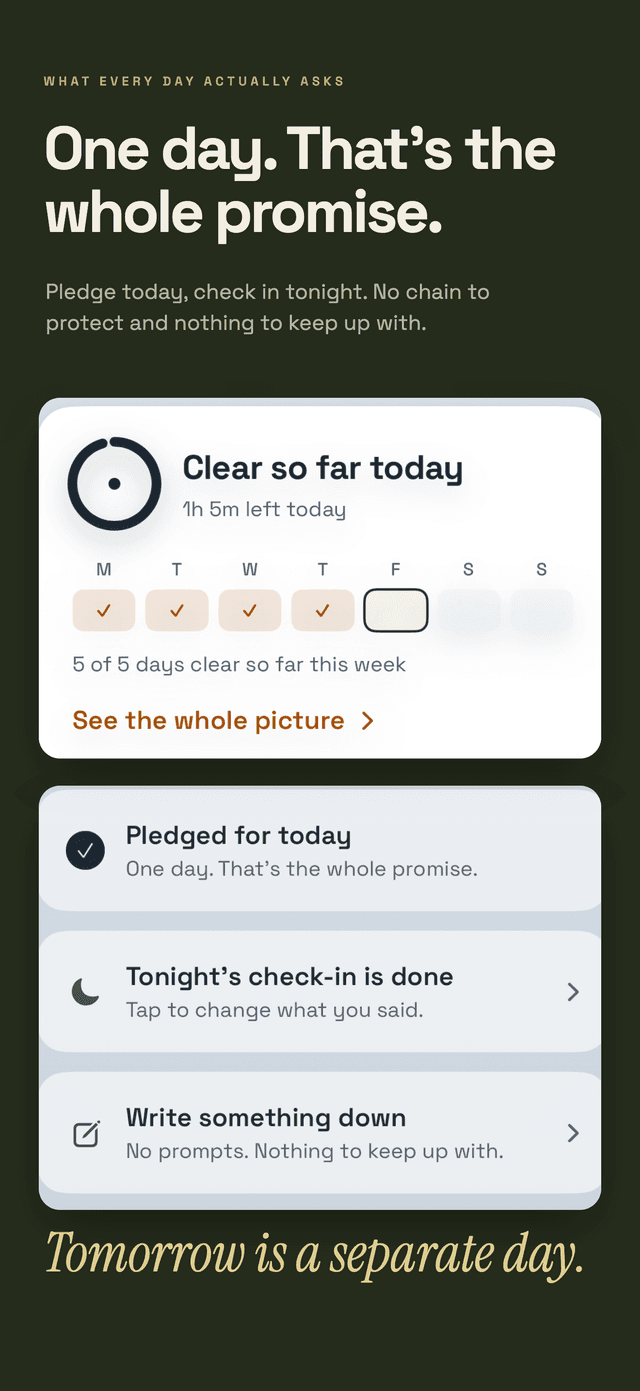
If you use Hard Bit, you write a reason when you set up gaming as a habit. That sentence appears in the hard-moment flow alongside a breathing step and what gaming has already cost you. Your sentence and the hard-moment button are free. Each habit keeps its own reason, which is why keeping separate reasons for each habit matters if you are working on more than one. The app is optional. The principle is to put the words in the spot you will be when the urge starts.
Revise the reason when it stops landing
Reasons wear out. A sentence that moved you in week one can feel like background noise by week six. That is normal, not evidence that you have stopped caring.
Revise when:
- you read it and feel nothing,
- your circumstances change, such as a new job, a new relationship, or exams finishing,
- you had a slip and the sentence did not help.
After a slip, look at what happened rather than throwing out the reason. Did you read it? Was it the wrong reason for that situation? A slip after a stressful day may need a reason about rest, not productivity. Recording the slip honestly and adjusting one thing is more useful than starting from zero. Our guide on what to do after a slip without erasing your progress walks through that review, and it also helps to measure progress beyond a perfect streak.
Keep old versions. Reading how your reasons changed can show what has improved.
When a reason is not enough
A written reason is a self-help tool. It cannot assess what is happening or replace support.
The World Health Organization recognizes gaming disorder in ICD-11. It describes a pattern of impaired control over gaming, gaming taking priority over other interests and daily activities, and continuing despite harm, severe enough to significantly affect daily life and normally evident over at least 12 months. WHO notes that this affects only a small proportion of people who game. This article does not diagnose anyone, and gaming a lot does not mean you have a disorder.
If gaming feels hard to control and is seriously affecting your sleep, work, study, relationships, or mood, talk to a GP or a mental health professional. In England, the NHS National Centre for Gaming Disorders treats people aged 13 and over and accepts self-referrals. It currently offers parent support only for parents of young people aged 13 to 16. If you are in crisis or immediate danger, contact emergency services. Our editorial policy explains how we choose and review health sources.
Frequently asked questions
What are good reasons to quit gaming?
The best reasons are your own and concrete: getting your sleep back, being present with a specific person, finishing something you have put off, or not feeling flat after long sessions. General reasons can be a starting point. They usually work better once you tie them to a real part of your week.
Should I write more than one reason?
Keep one main sentence for difficult moments, because a long list is hard to read under pressure. You can keep a fuller list of costs elsewhere and swap in a different sentence if your hardest moments change.
What if my reason stops motivating me?
That is common. Rewrite it in fresh words, or anchor it to a more recent cost. Check that it still matches your goal, whether that is stopping or cutting down, and the situations where you usually struggle.
Is it okay if my reason is about someone else?
Yes, if it is something you also want. "I want to be awake for breakfast with my kids" is your reason too. A reason that only exists because someone else is unhappy with you may be harder to rely on when they are not around.
Can a reason alone help me stop gaming?
For some people it helps a lot. For others it works best combined with changes to their environment, a craving plan, and support. If gaming is causing serious harm, professional help can add what a written sentence cannot.