If you are working out what to do after a gambling slip, start with the money, not the post-mortem. End the session, log out, and move away from the phone or venue. Then protect what is left: turn on your bank's gambling block, restore any self-exclusion, and check which bills are due soon. Tell one person what happened. Work out why it happened tomorrow, when you are calmer.
A slip is serious, but it is not the end of the effort you have already made. The sections below take things in order.
Stop the session and put distance between you and the money
The hour after a slip can be risky. You may feel a pull to win the money back, to keep going because "today is ruined anyway", or to hide what happened. None of these needs a decision right now.
Do the physical things first:
- close the app or site and log out completely,
- leave the venue, or move the phone to another room,
- if it feels safe and you choose to, give your cards to someone you trust for the night,
- don't move money between accounts or apply for credit tonight.
If you notice the thought "one more bet will fix this", our guide on pausing before chasing a gambling loss covers that moment in more detail. If the whole evening feels hard, getting through a difficult gambling night breaks it into smaller steps.
Put the barriers back up
Many slips happen because a barrier was missing, had expired, or was easy to get around. Restoring them is practical self-protection, not a punishment.
What UK services describe:
- Bank gambling blocks. MoneyHelper says many banks and building societies let you block gambling transactions on your debit card, often from the banking app. Some banks also make you wait before a block can be switched off. The rules differ by bank.
- Self-exclusion. GAMSTOP is a free scheme for online gambling with operators licensed in Great Britain. You choose a minimum exclusion period, and you cannot remove it during that period. GamCare does not run self-exclusion itself, but its advisers can point you to GAMSTOP and to schemes for venues.
- Operator controls. If you still have accounts open, the gambling company's own time-out or closure options can act quickly while you set up wider blocks.
If a barrier failed, note how. Maybe the block had lapsed, or you used a different account or card. That detail becomes part of tomorrow's plan. For a deeper look at evening access, see making late-night gambling access harder.
Check what the slip has put at risk this week
Shame often makes people avoid their bank balance. A quick, factual check usually feels less frightening than the unknown.
Write down:
- how much was spent, as one total,
- what is due in the next seven days: rent or mortgage, energy, council tax, loan payments,
- what money is left to cover those bills.
MoneyHelper advises paying priority bills such as rent, mortgage, and utilities first, and points to free, confidential debt advice. A debt adviser can also help you contact creditors about an affordable plan. If the slip means a priority bill will be missed, contact a debt adviser before the due date rather than after.
Avoid two things. Don't use borrowed money to "fix" the gap, and don't plan to win it back. Both turn one loss into the next slip.
Tell one person, in one sentence
Hiding a slip often costs more than the slip itself, because secrecy makes the next one easier. You don't need to explain everything. A short message is enough:
I gambled tonight and lost £140. I'm safe, my cards are blocked, and I'd like to talk tomorrow.
If no one in your life feels safe to tell, a helpline adviser counts. The National Gambling Helpline, run by GamCare, is free and available 24 hours a day on 0808 8020 133, with live chat on GamCare's website. Advisers can also help you find local treatment. The NHS page lists specialist NHS gambling services in England.
If you are outside Great Britain, look for your country's or state's gambling helpline. The services named here are UK-specific.
Record the slip without starting your story again from zero
When you have slept, write down the sequence while it is still clear. Stick to facts, not a verdict on yourself:
- When: day and time the urge started, and when you placed the first bet.
- Before: what happened in the hour before: payday, a match, an argument, boredom, a promotion, a drink.
- Access: which account, card, or app made it possible.
- Amount: the total, written once.
- After: what you did when you stopped.
"Saturday, 10:40pm, after the match ended. Opened an old account that was not on my block. £140 over 50 minutes" is useful. "I'm hopeless" is not a plan.
Gambling Help Online describes how all-or-nothing thinking after a lapse ("I've blown it", "I'll never stop") can lead to more gambling. It suggests treating the slip as a setback you can recover from, and reflecting on the situation that came before it. A clear record helps you do that.
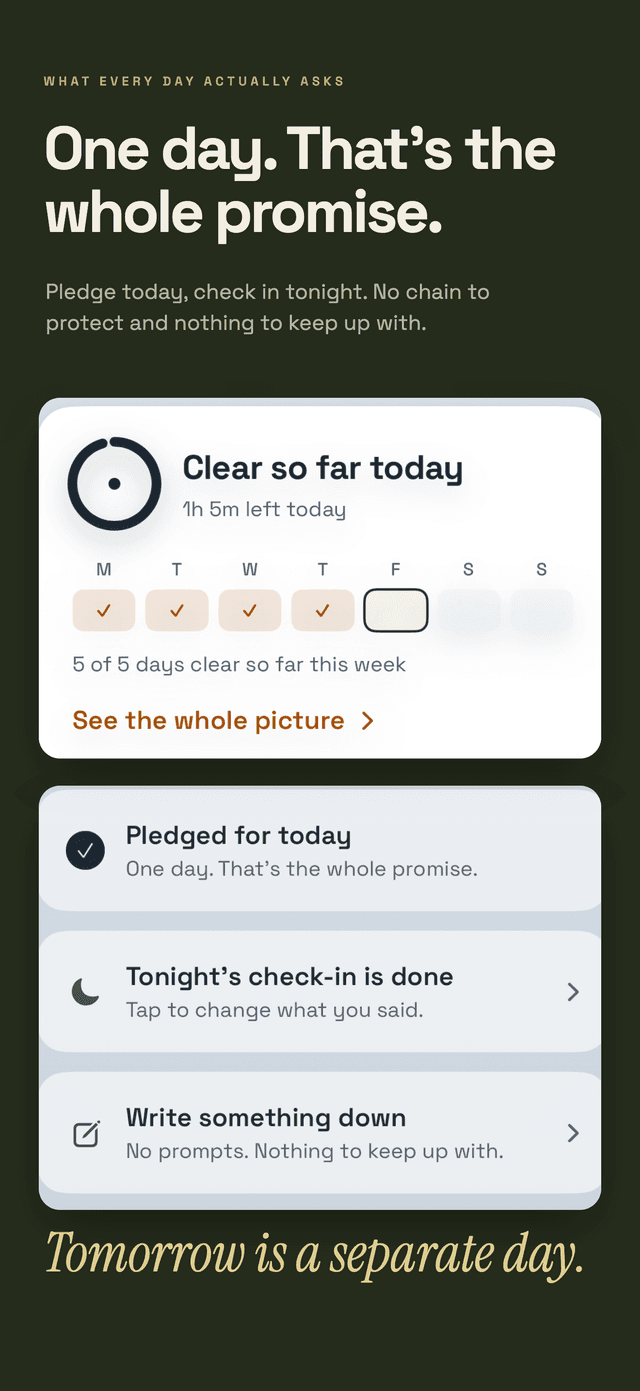
If you use Hard Bit, you can log the slip on your gambling habit, including the money involved. It stays in your history without resetting your counter, so your earlier clear days still count and the slip still shows. The journal can hold the sequence notes. Logging, the counter, and the journal are free. The difficult-hour forecast and pattern views are part of the subscription. Everything stays on your iPhone, with no account. Hard Bit is a tracker, not a gambling blocker or a treatment. The Hard Bit overview explains how the pieces fit together, and a paper notebook works on the same principle.
If writing about it brings up a lot of shame, our guide on tracking gambling without turning it into shame suggests neutral wording that still keeps the record honest.
Find the earliest point you could change next time
The bet is often the last step in a longer chain. Work backward from it:
- Was there a notification, a match, or an advert?
- Did payday or a bonus land that day?
- Was it the same hour as previous slips?
- Did a barrier lapse, or was there an account it didn't cover?
Then choose one change at the earliest realistic point, written as an if-then plan:
- "If payday falls on a Friday, I'll move the bill money into a separate account before lunch."
- "If I'm watching late football alone, my phone charges in the kitchen from half-time."
- "If a gambling email arrives, I'll delete it without opening it and check my block is still on."
One specific change you'll actually make is better than a long list of promises made in the hours after a loss. For the same method applied to any habit, see what to do after a slip without erasing your progress.
Decide whether you need more support than before
For some people, a single slip handled quickly just confirms their plan, with one adjustment. Others notice that slips are repeating, getting bigger, or involving debt they cannot see a way out of. That is not a moral failure. It is a sign that the current level of support may not be enough.
Things to consider, depending on what fits:
- counselling or treatment through the helpline or an NHS gambling service,
- free debt advice to set up an affordable repayment plan,
- a longer self-exclusion period, or adding schemes for venues,
- asking a trusted person to share oversight of your finances for a while.
If the slip has left you feeling hopeless, or you are having thoughts of suicide or self-harm, treat that as urgent. In the UK, call 999 if you are in immediate danger, or call Samaritans free at any time on 116 123. Elsewhere, use your local emergency or crisis line.
A private tracker can show patterns, but it cannot assess risk, give financial advice, or provide treatment. Our editorial policy explains how we separate general information from professional guidance.
Measure the week, not just the streak
Once you're past the first day, look at progress in more than one way. Total gambling-free days, money kept, urges that passed without a bet, and how quickly you got back to your plan all show real change that a single streak can hide.
For ways to build that fuller picture, read measuring gambling progress beyond a perfect streak. To see what the slip cost alongside what you have kept over time, see tracking the money gambling used to cost.
Frequently asked questions
Is one gambling slip a relapse?
Services use the words differently. Some call a single episode a lapse and a return to old patterns a relapse. The label matters less than what you do next: secure your money, restore barriers, and work out what led to it. If slips are becoming more frequent or larger, treat that as a reason to get more support.
Should I try to win back what I lost?
No. Trying to win back losses usually means risking more money while you are upset, and it can turn one slip into a longer session. Treat the money as gone, protect what is left, and if bills are at risk, contact a free debt adviser.
Can I cancel my self-exclusion if I regret it later?
GAMSTOP says you cannot remove a self-exclusion during the minimum period you choose. That is deliberate, because it protects you on difficult days. Check GAMSTOP's current options before you register, so you choose a period you are comfortable with.
What if I'm too ashamed to tell anyone?
Start with someone who doesn't know you. The National Gambling Helpline is free and confidential, and advisers regularly hear from people who have just gambled again. Telling one person, even a stranger on a helpline, often makes the next step easier.
Will logging the slip make me feel worse?
It can feel uncomfortable at first. Keep the entry factual: time, trigger, access, amount. Leave out judgments about your character. An honest record that keeps your earlier clear days alongside the slip is usually easier to learn from than one that wipes everything out and starts again.