To handle gaming cravings in the moment, first notice how close you already are to playing. Is the console off, is the launcher open, or are you already sitting in a lobby? Then add one step of distance that suits that stage. Stand up, put the controller or phone in another room, or close the client. Delay the decision with a prepared bridge activity, reread a reason you wrote earlier, and note afterward what happened. If gaming is tied to crisis, thoughts of self-harm, or spending you cannot control, contact support rather than relying on a routine.
You are not trying to win a debate with the urge. You are trying to make the next decision a deliberate one.
This guide is for gaming urges specifically. For a version that works with any habit, see how to handle a craving in the moment. If the whole evening feels hard, how to get through a difficult gaming night breaks it into stages.
Work out how close you are to playing
Gaming cravings show up at different distances from the game, and the right move depends on which one you are at.
- Far: the device is off and you are thinking about it. Maybe you are bored on the sofa, or you have just finished a task.
- Close: the console is on, the launcher is open, or your thumb is hovering over the icon.
- Inside: you are already in a menu, a queue, or the end screen of a match.
Name it plainly: "I want to play, and the launcher is already open." That one sentence describes where you are without passing judgment on you, and it tells you which section below to use.
The further away you are, the less effort it takes to change course. Stopping before the console boots is usually easier than leaving a lobby with friends waiting. That is why it helps to catch the early signs.
Add one step of distance
Change your surroundings before you test your willpower. Pick the change that fits your setup.
Console: Put the controller in a drawer in another room, or switch the console off at the wall rather than leaving it in rest mode. If the TV is the cue, sit in a different chair or a different room.
PC: Close the game client completely so it stops sitting in the system tray. Standing up and leaving the desk is more useful than staring at the desktop trying not to click.
Phone: Put the phone on charge out of arm's reach. If one game keeps pulling you back, move it off your home screen into a folder for now, so opening it takes a few deliberate taps.
None of this makes playing impossible. It adds a short gap between impulse and action, and that gap is where you get to choose. If a change does nothing for you, try a different one rather than concluding you lack discipline.
Treat invites and notifications as their own cue
A message from a friend saying "on tonight?", a party invite, or a notification that a squad is online can trigger a craving that has more to do with belonging than with the game.
Give that moment its own answer, written in advance so you are not composing it under pressure:
Not tonight, I'm taking a break. Up for a call on Saturday instead?
Sending a reply like this keeps the friendship and turns down the session. If you get the same invite at the same hour every week, mute that group's notifications for that window, or tell one friend about your goal so they stop sending invites. Being left out can feel bad, and naming that honestly is part of the plan.
Ride out the urge without arguing with it
Urge surfing is a coping technique from addiction research. You treat a craving as a sensation that rises, peaks, and changes, and you watch it instead of obeying or fighting it. To try it:
- Sit or stand with both feet on the floor.
- Notice where you feel the pull, such as restless hands, a tight chest, or a racing thought about one more match.
- Breathe out a little longer than you breathe in.
- Describe the urge to yourself as it changes: stronger, steady, a bit weaker.
The evidence is more modest than many articles suggest. A randomised study of brief urge-surfing instructions for 123 college smokers found that reported urges were not significantly different from those of a control group. The authors suggest the technique may change how people respond to an urge rather than make it disappear. That research was about smoking, not gaming, so treat urge surfing as something to test, not something proven for games. For a longer walkthrough, see what urge surfing is and how to practise it.
There is no fixed time after which a gaming craving ends. Some fade quickly, and some come back in waves across an evening. Use a short delay, such as "I'll decide after I've washed up", to give yourself room to decide. It is not a countdown that guarantees anything.
Pick a bridge activity that meets the same need
A bridge activity works best when it meets some of the need the game was meeting. Ask yourself what you actually want right now.
- Something to do: a short task with a clear end, such as washing up, a ten-minute walk, or tidying one shelf. Boredom and gaming urges goes deeper on building a better default.
- Relief from stress: a shower without your phone, stepping outside, or writing down the thing that is bothering you. If stress makes gaming feel automatic, this guide to stress-driven gaming covers that pattern.
- Company: a call or voice message to someone, or sitting in a room with other people.
- Progress or mastery: a puzzle, an instrument, a workout you log, or a few pages of a book with a bookmark you can move.
This is practical editorial advice rather than tested treatment. Prepare one or two options in advance, because a long menu is hard to use when attention has narrowed. If you prefer to set this up while calm, make a craving plan for gaming before you need it.
If you are already in the game
Being in a menu or between matches does not mean the evening is settled. Choose a stopping point that does not rely on how you feel in the moment:
- Leave at the next natural break, such as the end screen, a save point, or the return to the lobby, and do not queue again.
- Before you leave, say out loud or type what you will do next.
- Physically put the controller or phone down before you think about the next match.
If "one more" tends to turn into hours, how to stop one more match from becoming the whole night has specific exit strategies.
Playing does not wipe out the effort you made. Note it and go back to the plan.
Bring back the reason you wrote earlier
When a craving is loud, it is hard to remember why you wanted to change. A sentence you wrote earlier, in a calmer moment, is usually clearer:
- "I want to be awake for my first lecture."
- "I want my evenings to include people again."
- "I want to finish the project I keep postponing."
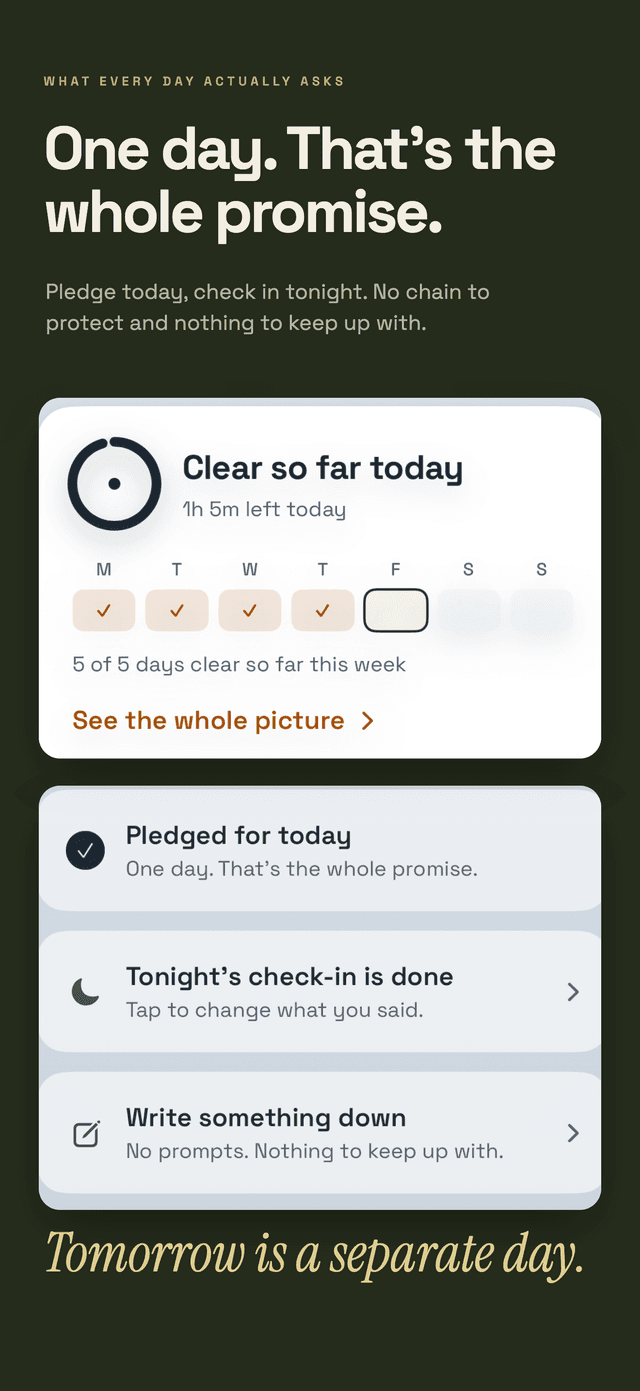
Hard Bit is an optional iPhone app. It keeps your personal sentence and shows it in the hard-moment flow, next to free, private logging for the gaming habit you set up. You choose whether your goal is to stop or cut down. The Hard Bit overview explains how this fits with the counter and logs, which stay on your phone with no account. A note on paper works too. What matters is having your own words ready.
Avoid wording that insults you. Shame tends to add to the stress you are trying to get away from.
Know when a craving points to a bigger problem
Most gaming cravings do not mean a disorder. The World Health Organization describes gaming disorder as a pattern of impaired control, increasing priority given to gaming over other activities, and continuing despite negative consequences. It is normally evident for at least 12 months and causes significant impairment. WHO notes that studies suggest only a small proportion of people who game are affected.
You do not need a label to ask for help. Consider professional support if gaming regularly takes the place of sleep, meals, work, school, or relationships, or if you have tried several times to cut down without success. In England, the NHS National Centre for Gaming Disorders works with people aged 13 and over who find their gaming difficult to control, accepts self-referrals, and delivers treatment mainly online. Elsewhere, a GP or local mental health service is a sensible first contact.
If in-game spending is part of the problem, removing saved payment methods or setting purchase limits on the device can help, alongside support.
A specialist clinic is not the route for an emergency. If you are having thoughts of self-harm or are in immediate danger, contact emergency services now. In the UK and Ireland, Samaritans answers on 116 123. In the US, you can call or text 988. Our editorial policy explains how we separate general information from product content.
Record the moment once it has passed
When things have calmed down, write one or two lines: the time, what came just before the urge, what you tried, and whether you played. An honest entry is more useful than a flattering one.
You will need a few entries before patterns show up, such as a particular weekday after work, or the hour after a hard call. Tracking gaming without turning it into shame explains how to keep these notes factual rather than punishing. In Hard Bit Plus, the forecast is worked out on your phone from your own logs. It makes no prediction until you have five entries and relies more on your own history as entries build up.
Judge progress by more than an unbroken streak. Count the cravings you got through, the shorter sessions, and how quickly you got back to your plan. Measuring gaming progress beyond a perfect streak suggests some useful measures.
Frequently asked questions
How long does a gaming craving last?
There is no reliable fixed duration. A craving can rise and fall, and it may come back later in the evening. Use a short delay to create space for a decision, not as a promise that the urge will be gone by a certain minute.
Is it better to distract myself or sit with the urge?
Either can help, and many people use both. Urge surfing means noticing the craving without acting on it. A bridge activity gives your hands and attention something else to do. If sitting with the urge makes you more distressed, choose the activity.
Does feeling strong cravings mean I have gaming disorder?
No. Cravings are common, and WHO describes gaming disorder as a sustained pattern that causes significant harm, normally over at least 12 months. If gaming is regularly harming your sleep, work, study, or relationships, a professional can help you assess it.
Should I delete my games completely?
Some people find a full break easier. Others prefer to cut down with clear limits. Either way, you can start by adding friction: close clients, move apps off your home screen, and keep controllers out of the room. If cutting down keeps failing, a firmer break or professional support may suit you better.